
The artificial intelligence field is moving fast and the demand for high-performance GPU infrastructure is at an all-time high. Today’s workloads require massive computational resources to train large language models, run computer vision algorithms, power recommendation systems and generative AI applications.
So, no one is choosing a cloud provider on their storage or virtual machines anymore. Today, availability of GPUs, scalability, pricing, networking, and developer experience are heavily impacting decision making. And the change has also forced organisations to look at aws alternatives that can offer dedicated GPU infrastructure and more predictable pricing.
In 2026 there are a few strong contenders in the market, each for different use cases. Companies can use their knowledge of their strengths to select the right platform to develop and deploy AI.
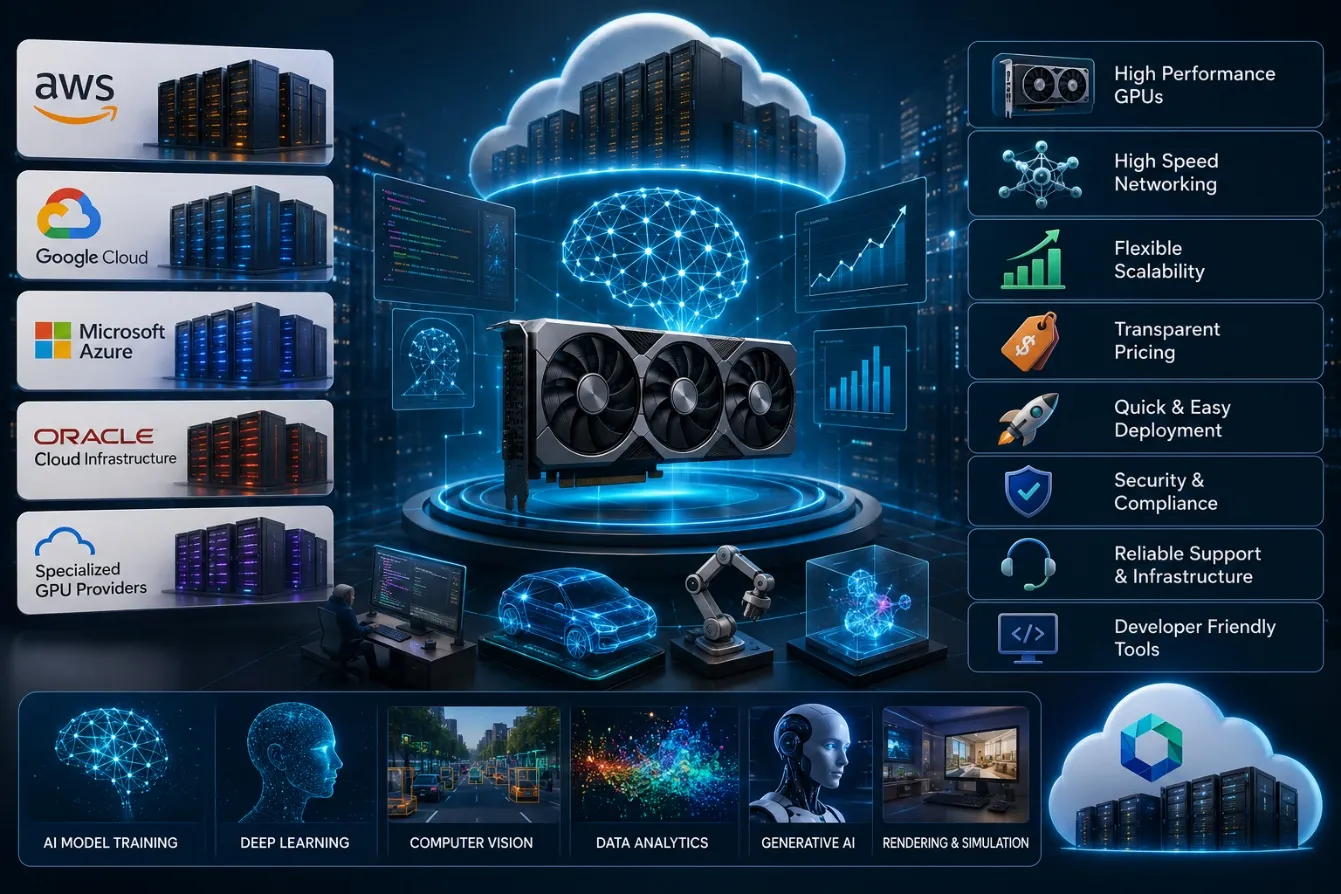
What Makes a Great AI GPU Cloud?
Before you jump into provider comparisons, you need to know what matters most for your AI workloads.
What a quality GPU cloud platform should provide:
-
Access to newest professional GPUs.
-
High bandwidth networking for distributed training.
-
Options to Scale Flexibly
-
Fair and transparent pricing.
-
Provision compute resources quickly.
-
Reliable uptime and infrastructure.
-
Tools for developer management.
-
Strong security and compliance features.
These parameters are crucial factors which could affect running costs & the organisation’s overall performance for organisations who are running and training complicated models and processing bulk data sets.
Why Businesses Are Looking Beyond Traditional Hyperscalers
While big cloud providers still dominate the market, there are a number of organisations exploring AWS alternatives designed for AI workloads, particularly those that centre on GPU performance and cost efficiency.
The most common reasons are:
-
Expensive infrastructure for long running AI jobs.
-
Advanced pricing models.
-
Dedicated GPU setups.
-
Ease research and experimenting at a large scale.
-
Better support for specialized machine learning workflows.
More businesses are turning to solutions built for GPU intensive computing rather than one size fits all solutions.
CloudPe: Built for Modern AI Workloads
CloudPe is an attractive alternative for enterprises looking for enterprise-grade GPU infra without the extra fluff. Instead of asking customers to browse a large catalogue of unrelated cloud services, CloudPe is focused on providing scalable compute resources to demanding applications such as machine learning, deep learning, simulation and rendering.
The infrastructure is ideal for organizations that need high-performance GPUs like the RTX Pro 6000 to train and infer AI models. Teams can provision resources quickly, scale capacity as projects evolve, and avoid the capital expense of hosting expensive on-premises hardware.
CloudPe is one of the most practical aws alternatives for startups, research institutions and enterprises for GPU centric workloads.
Amazon Web Services (AWS)
AWS continues to be one of the world’s largest cloud vendors, with a broad offering of GPU-enabled instances for machine learning and high performance computing. Its ecosystem includes managed AI services, broad regional availability and integration with various developer tools.
But for many organisations, costs can quickly spiral out of control as GPU usage increases. Storage, networking and support services can also have multiple pricing components, which can make budgeting difficult. Because of these factors, businesses have begun looking into specialised platforms with a higher concentration of GPUs.
Google Cloud Platform
Google Cloud has become a major force in AI by providing a mix of powerful infrastructure, machine learning services, and access to specialized accelerators.
It’s rich data analytics ecosystem and AI tooling makes it attractive for research intensive workloads. However, depending on their operational priorities, for example overall cost, flexibility and simplicity, organisations may want to consider alternative providers.
Microsoft Azure
Microsoft Azure Azure has enterprise-grade GPU infrastructure, embedded within Microsoft’s cloud ecosystem. Seamless integration with identity management, analytics and productivity platforms is provided for organizations that have already invested in Microsoft technologies.
This is a favourite among large enterprises with hybrid cloud strategies, although some AI-centric teams may favour providers that have simpler GPU provisioning and pricing models.
Oracle Cloud Infrastructure
Oracle has gone all-in on AI infrastructure and massive GPU clusters, making it a much harder platform for compute intensive applications. It continues to deliver powerful configurations for enterprise AI projects and high performance computing.
The integration is helpful for organisations that already use Oracle technologies, but the choice of platform will depend on the nature of the workloads and the costs involved.
Specialised GPU Cloud Providers
The fast-growing generative AI has spawned a new class of GPU-first cloud platforms designed for machine learning and accelerated computing. These providers often promise flexible pricing, easy deployment and access to the latest GPU hardware.
For many AI startups, these specialised services are now supplementing or replacing traditional hyperscalers to optimise performance and infrastructure costs.
This is part of a broader trend, reflecting the fact that demand for aws alternatives is still growing across the technology space.
Factors to Consider Before Choosing a Provider
There is no one size fits all cloud platform, as every organisation needs its own infrastructure.
What to think about before you choose:
GPU Availability
Check the provider has the right hardware for your workloads, such as enough memory and AI acceleration capabilities.
Pricing Transparency
Find out the hourly rate, storage costs, networking costs and any other operational costs.
Scalability
Projects tend to change quickly. Choose infrastructure that lets you scale resources without downtime.
Ease of Deployment
Developer friendly interfaces & automation reduces operational complexities, accelerates experiments & increases experimentation cycle time
Support and Reliability
Responsive technical support and reliable infrastructure mean less downtime during critical production workloads.
Security
Ensure the provider has proper access controls, encryption and compliance standards for sensitive AI data.
Why CloudPe Stands Out
CloudPe is one of the increasing list of aws alternatives that are more focused on practical GPU computing, avoiding to overwhelm the users with too much infrastructure complexity.
The main benefits are :
-
High Performance GPU Resources for AI and ML
-
Can be scaled flexibly to any project size.
-
Management of infrastructure. Transparency.
-
Easy to deploy.
-
Cost effective cloud computing for GPU intensive workloads
-
Infrastructure for startups, research and enterprise teams.
CloudPe accelerates innovation and boosts operational efficiency and provides organisations with access to cutting-edge GPU capabilities without the need to buy expensive hardware.
The Future of AI Infrastructure
Artificial intelligence models are getting larger and more complex. As datasets grow and the demands for training increase, companies will be more dependent on scalable GPU infrastructure.
This means a rise in demand for cloud platforms designed to deliver accelerated compute capabilities, but also cost transparency and ease of management. Those that invest in flexible infrastructure now will be better placed to respond as these new AI solutions develop and mature.
Final Thoughts
It will depend on your tech Stack, budget and strategic goals what the best GPU cloud provider in 2026 will be for you. Many AI teams are actively looking for aws alternatives that offer easier deployment, specialized GPU resources and better cost efficiency while large hyperscalers continue to be popular choices for organizations seeking broad ecosystems.
CloudPe is the next generation cloud infrastructure that provides enterprise-grade GPU performance for AI, machine learning, rendering and high-performance computing. A modern GPU-centric platform can offer a major competitive advantage for companies that want to accelerate model training, scale smarter, and lower infrastructure complexity.