
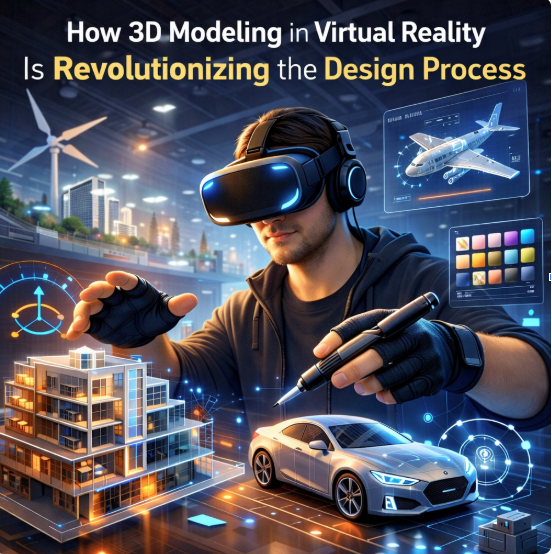
The new revolution in immersive visualization has just begun. With the growing need for more insights, accuracy, and interest in unbuilt space, the need for more effective visualization tools has become the highest priority. The problem with the existing visualization tools is that they are no longer sufficient in meeting the demands of the industry.
This is because the static image, 3D models on screens, and even high-quality animations are still creating a distance between the viewer and the design. This distance is now being removed by 3D modeling in virtual reality, which is redefining immersive visualization.
The major difference between virtual reality and other visualization tools is that it allows the viewer to be inside the design. This is because instead of viewing the design from the outside, virtual reality allows the viewer to be inside the design. This transition from viewing to experiencing has completely changed the application of visualization.
The Evolution of Immersive Visualization
The application of visualization has always been a process of communication. This is because the first application of a 3D visualization company was done through drawings. Later, visualization became more realistic through the application of renderings. The current application of visualization is through animations. However, all these applications of visualization require interpretation. This is because the viewer requires interpretation of the visualization in order to understand it in reality.
The problem with virtual reality is that it does not require interpretation. This is because immersive visualization enables the user to walk through the space and understand the space as it is.
This is why immersive visualization is no longer an add-on feature in presentations but a part of the design and decision-making process.
Redefining Accuracy with Human-Scale Interaction
Accuracy in visualization is not only about the dimensions; it is about whether the space is functional or not. Visualization is accurate in terms of dimensions but cannot determine whether the space is functional or not.
Functional issues can be identified early on by immersive visualization. It becomes easy to identify whether something is not right in space: whether it is too small, whether it is obstructing the path of movement, or whether it is properly scaled for human comfort.
These issues are hard to identify, almost impossible, on flat screens.
Immersive environments enable multiple teams to validate designs at full scale, allowing them to optimize designs, scale, and decisions before the construction or production process.
Changing the Way Stakeholders Communicate
One of the most significant ways in which immersive visualization is changing the way stakeholders communicate is by eliminating misunderstandings between designers, clients, consultants, and decision-makers. Misunderstandings are common and costly.
Virtual reality provides a common experience. Everyone is looking at the same space from the same perspective and at the same scale. Feedback is more precise because everyone is pointing to the same spot and talking about what they see, not what they see in their mind’s eye.
This eliminates misalignment, reduces approval time, and increases confidence in all stakeholders.
From Visualization to Decision-Making Platform
Designers can compare various layout, material, or design options and understand the effect of each option immediately. Designers are no longer making decisions based on their imagination but on experience.
Thus, 3D modeling in virtual reality makes visualization an active process of design and validation rather than a passive process.
Improving Design Iteration and Creativity
Design is an iterative process. There are expected changes, but every change has to be carefully evaluated to make sure that it does not create more problems than it solves.
Immersive design enables fast iteration. Designers can implement changes and view them immediately in the design. This enables creativity and investigation while keeping things organized and under control.
Immersive visualization does not limit creativity but enables designers to investigate their ideas without any limitations and with their feet on the ground and eyes on real-world functionality and size.
Facilitating Complex and Large-Scale Projects
As projects become more complex and larger in scale, traditional visualization tools do not give a complete picture of the project. Campuses, mixed-use projects, infrastructure hubs, and industrial projects are complex projects that involve complex relationships in space that are difficult to understand on a screen.
Virtual reality environments enable users to understand these relationships intuitively. Users can walk through large-scale projects, evaluate transitions between spaces, and understand how various elements relate to each other in space. This big-picture understanding is essential for successful coordination, planning, and ultimate success.
Improving Client Confidence and Trust
The clients can accept the designs without understanding what it is like to experience them once the project is completed. This can lead to the clients changing their minds or altering things at the very end.
Immersive visualization is the answer to this challenge. The clients can walk through the space and understand the scale in a natural way and be assured of their design choices.
Reducing Risk and Future Expenditures
Mistakes in design that are identified during the construction or production stage can be costly. Immersive visualization enables the correction of mistakes at a time when it is still possible and feasible to correct them.
Mistakes can be corrected before they become costly mistakes. Over time, this means that risk is reduced in terms of cost savings.
Immersive visualization enables the correction of mistakes before they become costly mistakes. Over time, this means that risk is reduced in terms of cost savings.
This practical application is one of the reasons why immersive visualization has become less of a luxury item and more of a necessity.
Future-Proofing the World of Visualization
The future of visualization is interactive, immersive, and experiential. As digital twin technology, real-time simulation, and mixed reality advance, immersive modeling will be the building block for these technologies.
The virtual world of today can be the world of tomorrow’s operations. This can be leveraged for facility management, training, and optimization. This future-proofing aspect further emphasizes the importance of immersive visualization as a strategic enabler.
Conclusion
The definition of immersive visualization is no longer based on the realism of an image but on the accuracy of space experience. 3D modeling in virtual reality is redefining the definition of this standard by offering an opportunity to be inside the space and make decisions based on actual experience rather than interpretation.
Immersive modeling has redefined the concept of visualization from being a presentation tool to a basic process of modern design by adding value to accuracy, communication, confident decision-making, and risk management. As the bar continues to be raised in terms of expectations, virtual reality visualization is setting a new standard for exploring, validating, and realizing ideas.